|
Current
Projects
|
Dielectrophoresis-based micropumping and self-assembly of nanostructures
We have demonstrated an unique way for microscale flow control by exploiting the electrokinetic effect, dielectrophoresis (DEP). In this work, we studied the fundamentals of electromechanics of micro/nanoparticles under DEP and their hydrodynamic interaction with the flow field, and proposed a novel micropumping scheme which can be used in a wide range of microfluidic applications, including on-chip cooling and lab-on-a-chip devices (a US patent has been filed). In addition, we have developed comprehensive numerical models, using Maxwell stress tensor approach and Brownian dynamics, to understand the colloidal electrohydrodynamics associated with DEP-directed fluidic assembly of multiple nanostructures. This work will provide basic information for large-scale parallel manufacturing of functional devices that employs nanostructures as the building block for applications in nanoelectronics and two-dimensional photonic materials. This work is supported by NSF and Cooling Technologies Research Center (CTRC) at Purdue University.
|
|
Virtual scaffolds for spinal cord injury repairing
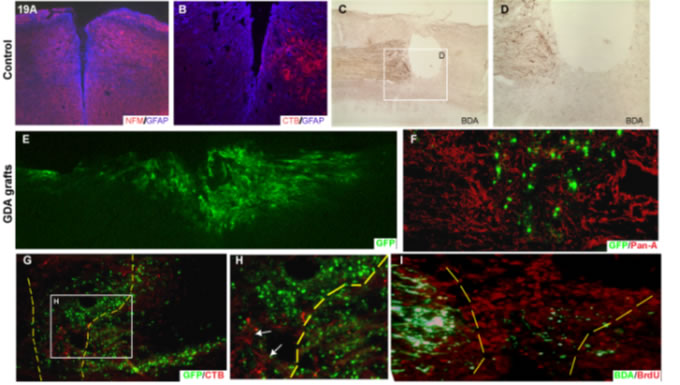
We are collaborating with Dr. Qilin Cao from University of Texas Health Science Center on developing a novel technique to fabricate virtual scaffolds for axonal regeneration after spinal cord injury (SCI). This research capitalizes on the ability of using magnetic field to manipulate neural stem cells, which are labeled with nanoengineered cationic magnetoliposomes, remotely and noninvasively, thereby guiding the directional growth of axons to repair the injured spinal cord. This work will not only benefit hundreds of thousands of Americans who are paralyzed or have severely limited mobility incurring from SCI, but it will also shift the paradigm for applications in regenerative medicine and tissue engineering which require directional guidance of the cells or tissues. This work is supported by NSF and DoD (through Methodist Hospital Research Institute).
Tunable adaptive nucleate boiling heat transfer surfaces with electrowetting
Together with Dr. Paul Ruchhoeft from Electrical and Computer Engineering at UH, we are exploiting the complimentary roles of hydrophobicity and hydrophilicity played in nucleate boiling and taking advantage of the ability of electrowetting to alter the surface wettability reversibly and robustly. This work will lead to a fundamental understanding of the effect of dynamically tunable surface wettability on nucleate boiling, and provide a previously unexplored and powerful tool to actively control and optimize the key nucleate boiling processes. This work is supported by NSF.
Past Work
Single-Phase Thermal Transport
of Nanofluids
We have systematically investigated single-phase and two-phase flow physics of nanofluids, which are engineered colloids containing dispersed nanoparticles, and elucidated the crucial role of particle-fluid and particle-particle interactions in determining the thermophysical property and transport characteristics of nanofluids with both spherical and non-spherical nanoparticles. Our results revealed the critical aspects of the long-standing myth of nanofluids and their effectiveness as a potential candidate for advanced heat transfer fluids. This work will be very useful in the design of liquid cooling systems employing nanofluids for thermal management of next-generation electronics.

Friction factor vs. Re |

Nusselt number vs. Re |
Two-Phase Flow with
Surfactants in a Microchannel
Addition of surfactants to liquids
helps to eliminate intermittent two-phase flow patterns and alleviate flow
instability. These features are very desirable for two-phase microfluidic
applications. However, very little information is available on the
two-phase flow pattern of surfactant solution in microchannels. The
present paper reports a study of adiabatic two-phase flow with surfactants in a
circular microchannel of a 180-µm diameter. Air-water mixtures with trace
quantities of sodium dodecyl sulfate (SDS) were used in the experiments.
The maximum superficial velocities measured were 4 m/s for the liquid and 65 m/s
for the gas. High-speed microphotographic technique was employed to
visualize various two-phase flow patterns and identify the transition boundaries
between flow regimes. The results were compared to data obtained from
air-water flow without surfactants. It was found that addition of
surfactants brings in significant modification to the two-phase flow regimes and
their transition characteristics in microchannels, in particular, slug flow is
effectively suppressed.
Study
of Two-Phase Flow Patterns in a Microfluidic ChipAccurate determination of the two-phase flow patterns in
microchannels is crucial to select appropriate predictive tools for pressure
drop, heat and mass transfer in the microfluidic devices. Most of the
prevailing two-phase flow maps were developed using visualization techniques and
fail to reveal the fundamental mechanisms that are responsible for the formation
of specific flow pattern under given flow conditions. In the present work, the
high-speed photographic method is employed to study the liquid-gas two-phase
flow in a cross-junction microfluidic chip with a rectangular cross section of
300 mm by 100 mm. The dynamics of bubbly, slug and
annular flows are measured. Numerical models using the VOF approach are
developed to simulate the two-phase mixing and flow pattern development in the
cross-junction device. The roles of the inertia, viscous shear and surface
tension forces in various flow patterns are discussed. The experimental results
and the simulation data together provide a comprehensive phenomenological
description of the key parameters and processes that govern the two-phase flow
pattern formation and development in microfluidic devices.

Primary flow patterns |

Numerical simulation vs. Visualization |

Bubbly flow simulation |

Slug flow simulation |
Infrared Micro-Particle Image
Velocimetry
A
non-intrusive diagnostic technique, infrared micro-particle image velocimetry
(IR-PIV), is developed for measuring flow fields within MEMS devices with
micron-scale resolution. This technique capitalizes on the transparency of
silicon in the infrared region, and overcomes the limitation posed by the lack
of optical access with visible light to sub-surface flow in silicon-based micro-
structures. Experiments with laminar flow of water in a circular
micro-capillary tube of hydraulic diameter 255 µm demonstrate the efficacy of
this technique. The experimental measurements agree very well with
velocity profiles predicted from laminar theory. Cross-correlation and
auto-correlation algorithms are employed to measure very-low and
moderate-to-high velocities, respectively; the former approach is suitable for
biomedical applications while the latter would be needed for measurements in
electronics cooling. The results indicate that the IR-PIV technique
effectively extends the application of regular micro-PIV techniques, and has
great potential for flow measurements in silicon-based microdevices.
Flow Boiling and Two-Phase
Flow in Microchannels
Flow boiling heat transfer to water in
microchannels is experimentally investigated. The dimensions of the
microchannels considered are 275 X 636 um and 406 X1063 um. The experiments are
conducted at inlet water temperatures in the range of 67 to 95 C and mass fluxes
of 221 to 1283 kg/m2s. The maximum heat flux investigated in the tests is 129
W/cm2 and the maximum exit quality is 0.2. Convective boiling heat transfer
coefficients are measured and compared to predictions from existing correlations
for larger channels. While an existing correlation was found to provide
satisfactory prediction of the heat transfer coefficient in subcooled boiling in
microchannels, saturated boiling was not well predicted by the correlations for
macrochannels. A new superposition model is developed to correlate the heat
transfer data in the saturated boiling regime in microchannel flows. In this
model, specific features of flow boiling in microchannels are incorporated while
deriving analytical solutions for the convection enhancement factor and nucleate
boiling suppression factor. Good agreement with the experimental measurements
indicates that this model is suitable for use in analyzing boiling heat transfer
in microchannel flows.
Single-Phase Transport in Microchannels
Single-phase fluid flow and
heat transport of water in microchannels is experimentally studied. Pressure
drop measurement with two alternative approaches is presented to account for
cases in which the influence of inlet/outlet plenums is pertinent or not, and
the results are compared to laminar and turbulent predictions. Transition to
turbulence and estimation of local pressure loss are also explored with flow
visualization and numerical analysis. Heat transfer measurements are performed
with an emphasis on correctly matching the entrance and thermal conditions when
comparing the results to conventional heat transfer correlations developed for
large-sized channels. The single-phase flow and heat transfer measurements
confirm that carefully applied conventional theory and correlations are adequate
in predicting transport characteristics in microchannels.
|